Requirements Engineering - Fundamentals, Principles, Techniques
Second Edition

This Textbook
- Is aimed at practitioners, students, and lecturers in the fields of systems and software engineering as well as business application development
- Provides a comprehensive and well-structured introduction to the fundamentals, principles, and techniques of requirements engineering (RE)
- Presents proven methods for eliciting, negotiating, documenting, validating, and managing requirements for software-intensive systems
- Illustrates fundamentals, principles, and techniques using numerous examples
Major Revision of First Edition
Based on a revised structure, the new edition contains new and comprehensively revised content, as well as current standards, methods, and techniques. It illustrates the content with extensive new and revised examples and offers new and revised checklists and tips for practical application. Important changes include:
- In-depth consideration of the context, including the distinction between eight context perspectives and the consideration of these perspectives in all requirements engineering activities, as well as (sub-)system-specific context consideration
- Clear differentiation between documentation and specification of requirements and context information
- Greater focus on innovation and creativity, including agility and creativity techniques
- Detailed consideration of the conflicts causes and conflict resolution strategies, which play a particularly important role in the development of innovative requirements
Structure of this Book
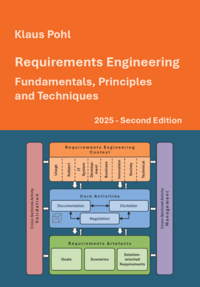
The book consists of five parts. Click on the part headings to learn more about the structure of the parts, sub-parts, and the corresponding chapters.
Part I Fundamentals and Framework
This part provides a comprehensive introduction to the fundamentals of requirements engineering, illustrates why requirements engineering is a critical success factor for any software and system development project, and describes our framework for requirements engineering, which is used to structure this book.
Part II Requirements Engineering Context
This part emphasizes the central role and influence of the requirements engineering context on software and system requirements, defines basic terms, and presents eight context perspectives to support the consideration of relevant context aspects in software and system development and to make the complexity of the context manageable.
This part presents the three core activities of requirements engineering in detail: elicitation, documentation, and negotiation of requirements and context information. For each core activity, the objectives, principles, and techniques are described, among other aspects.
Part IV Requirements Artefacts
This part describes the three main types of requirement artefacts: goals, scenarios and solution-oriented requirements. In short, goals document the intentions of the stakeholders, scenarios describe exemplary requirements and goal (non-)fulfilment, and solution-oriented requirements define the properties and characteristics of the system in the form of data, functions and behaviour at the required level of detail.
Part V Cross-Sectional Activities
This part describes the cross-sectional activities: validation and management. In both activities, we distinguish between the management and validation of the consideration and use of the requirements engineering context, the execution of the three core activities, and the documented and specified requirements artefacts.
Author

Teaching Material
You can download teaching material free of charge. The teaching material is licensed under CC BY-NC-SA 4.0. It consists of approximately 1,300 slides (21 slide sets), which are aligned with the book chapters. Note: Downloads are only available to employees of educational institutions.